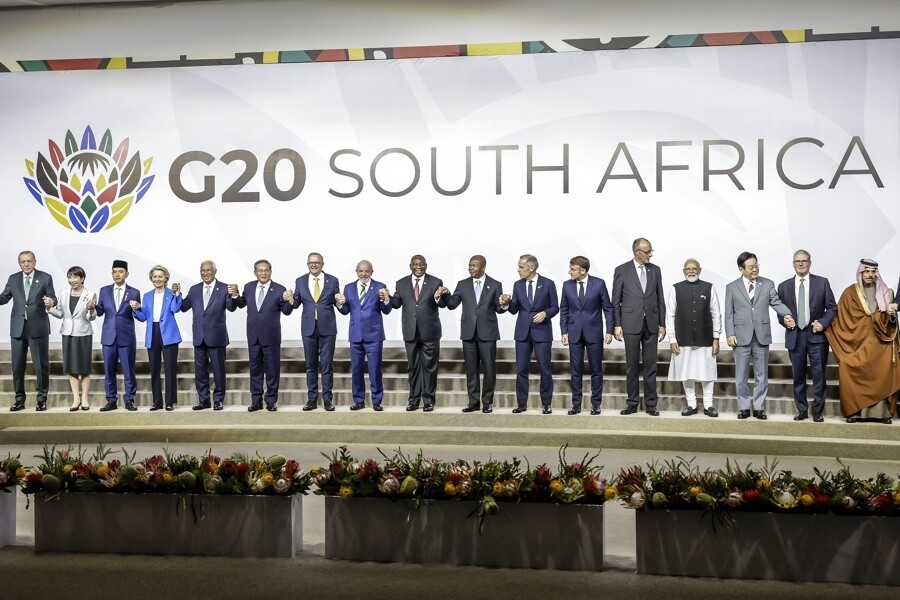
Leaders of the G20, gathered at the summit in Johannesburg, adopted a joint declaration on Saturday advocating for 'multilateral cooperation' and including resolutions on climate change, critical minerals, and a commitment to work for peace in conflicts in accordance with the UN Charter, despite Argentina's rejection and the absence of the US.
'We meet in a context of growing geopolitical and geoeconomic competition and instability, intensification of conflicts and wars, deepening inequality, growing uncertainty and global economic fragmentation. In this challenging political and socioeconomic environment, we reaffirm our conviction in multilateral cooperation to collectively address shared challenges,' the leaders underlined in the document.
Additionally, the leaders agreed that, 'guided in full by the Purposes and Principles of the Charter of the United Nations,' they would work 'for a just, comprehensive, and lasting peace in Sudan, the Democratic Republic of the Congo, the Occupied Palestinian Territory, and Ukraine,' as well as to end 'other conflicts and wars around the world'.
'Only with peace will we achieve sustainability and prosperity,' the declaration asserts.
The declaration is structured around the four priorities of South Africa's G20 presidency: strengthening resilience and disaster response; ensuring debt sustainability in low-income countries; mobilizing financing for a just energy transition and harnessing the potential of critical minerals to promote inclusive growth.
The text includes multiple references to climate change, including a firm commitment and the bloc's leadership role in tackling climate change by 'strengthening the full and effective implementation of the Paris Agreement,' which envisages greenhouse gas emission reductions.
Furthermore, the text reflects the adoption of a G20 Critical Minerals Framework, a 'voluntary and non-binding roadmap' aimed at ensuring that critical mineral resources become a 'driver of prosperity and sustainable development,' given the projected increase in demand for these materials.
As detailed in the declaration, this framework is designed to address the 'urgent need for international cooperation' to ensure sustainable, transparent, stable, and resilient critical mineral value chains.
The G20 leaders adopted this declaration at the start of the first day of the summit by an 'overwhelming majority' of member states, according to the forum's South African presidency, despite the absence of the US from the summit's discussions and Argentina's refusal to sign the text.
Argentina's Foreign Minister, Pablo Quirno, attending on behalf of President Javier Milei, explained in the plenary session that his country 'cannot' endorse the declaration due to 'discrepancies' with the agreed text.
Quirno criticized the text for focusing on 'a single dimension of a specific territory,' referring to the Israeli-Palestinian conflict, which 'overlooks the broader regional context, the international recognition of different entities, and the structural causes of the dispute.'